
Paul Hall Paul Hall
0 Course Enrolled • 0 Course CompletedBiography
Pass Guaranteed Accurate Snowflake - Exam ADA-C01 Quick Prep
What's more, part of that Pass4guide ADA-C01 dumps now are free: https://drive.google.com/open?id=1Kzrpg62JgsvtpqLhRVM5gXd8kEdxDjaH
More qualified certification for our future employment has the effect to be reckoned with, only to have enough qualification ADA-C01 certifications to prove their ability, can we get over rivals in the social competition. Many candidates be defeated by the difficulty of the ADA-C01 exam, but if you can know about our ADA-C01 Exam Materials, you will overcome the difficulty easily. If you want to buy our ADA-C01 exam questions please look at the features and the functions of our product on the web or try the free demo of our ADA-C01 exam questions.
Snowflake ADA-C01 Exam Syllabus Topics:
| Topic | Details |
|---|---|
| Topic 1 |
|
| Topic 2 |
|
| Topic 3 |
|
| Topic 4 |
|
| Topic 5 |
|
| Topic 6 |
|
| Topic 7 |
|
Place Your Order and Download Snowflake ADA-C01 Actual Questions Instantly
All these three SnowPro Advanced Administrator (ADA-C01) exam questions formats contain the actual, updated, and error-free SnowPro Advanced Administrator (ADA-C01) exam practice test questions that assist you in SnowPro Advanced Administrator (ADA-C01) exam preparation. Finally, With the Snowflake ADA-C01 Exam Questions you will be ready to get success in the final Snowflake ADA-C01 certification exam. Please choose the best SnowPro Advanced Administrator (ADA-C01) exam questions format and download it quickly and start this journey today.
Snowflake SnowPro Advanced Administrator Sample Questions (Q16-Q21):
NEW QUESTION # 16
What roles can be used to create network policies within Snowflake accounts? (Select THREE).
- A. Any role with the global permission of CREATE NETWORK POLICY
- B. SECURITYADMIN
- C. Any role that owns the database where the network policy is created
- D. ACCOUNTADMIN
- E. ORGADMIN
- F. SYSADMIN
Answer: A,B,D
Explanation:
Explanation
Network policies are used to restrict access to the Snowflake service and internal stages based on user IP address1. To create network policies, a role must have the global permission of CREATE NETWORK POLICY2. By default, the system-defined roles of SECURITYADMIN and ACCOUNTADMIN have this permission3. However, any other role can be granted this permission by an administrator4. Therefore, the answer is B, C, and E. The other options are incorrect because SYSADMIN and ORGADMIN do not have the CREATE NETWORK POLICY permission by default3, and network policies are not tied to specific databases5.
NEW QUESTION # 17
What is required for stages, without credentials, to limit data exfiltration after a storage integration and associated stages are created?
- A. ALTER ACCOUNT my_account SET
REQUIRE_STORAGE_INTEGRATION_FOR_STAGE_CREATION = true;
ALTER ACCOUNT my_account SET
REQUIRE_STORAGE_INTEGRATION FOR STAGE_OPERATION = true;
ALTER ACCOUNT my_account SET
PREVENT_UNLOAD_TO_INLINE_URL = true; - B. ALTER ACCOUNT my_account SET
REQUIRE_STORAGE_INTEGRATION_FOR_STAGE_CREATION = true;
ALTER ACCOUNT my_account SET
REQUIRE_STORAGE_INTEGRATION_FOR_STAGE_OPERATION = true;
ALTER ACCOUNT my_account SET
PREVENT_UNLOAD_TO_INLINE_URL = false; - C. ALTER ACCOUNT my_account SET
REQUIRE_STORAGE_INTEGRATION_FOR_STAGE_CREATION = false;
ALTER ACCOUNT my_account SET
REQUIRE_STORAGE_INTEGRATION_FOR_STAGE_OPERATION = false;
ALTER ACCOUNT my_account SET
PREVENT_UNLOAD_TO_INLINE_URL = true; - D. ALTER ACCOUNT my_account SET
REQUIRE_STORAGE_INTEGRATION_FOR_STAGE_CREATION = false;
ALTER ACCOUNT my_account SET
REQUIRE_STORAGE_INTEGRATION_FOR_STAGE_OPERATION = false;
ALTER ACCOUNT my_account SET
PREVENT_UNLOAD_TO_INLINE_URL = false;
Answer: A
Explanation:
According to the Snowflake documentation1, stages without credentials are a way to create external stages that use storage integrations to access data files in cloud storage without providing any credentials to Snowflake. Storage integrations are objects that define a trust relationship between Snowflake and a cloud provider, allowing Snowflake to authenticate and authorize access to the cloud storage. To limit data exfiltration after a storage integration and associated stages are created, the following account-level parameters can be set:
* REQUIRE_STORAGE_INTEGRATION_FOR_STAGE_CREATION: This parameter enforces that all external stages must be created using a storage integration. This prevents users from creating external stages with inline credentials or URLs that point to unauthorized locations.
* REQUIRE_STORAGE_INTEGRATION_FOR_STAGE_OPERATION: This parameter enforces that all operations on external stages, such as PUT, GET, COPY, and LIST, must use a storage integration. This prevents users from performing operations on external stages with inline credentials or URLs that point to unauthorized locations.
* PREVENT_UNLOAD_TO_INLINE_URL: This parameter prevents users from unloading data from Snowflake tables to inline URLs that do not use a storage integration. This prevents users from exporting data to unauthorized locations.
Therefore, the correct answer is option D, which sets all these parameters to true. Option A is incorrect because it sets PREVENT_UNLOAD_TO_INLINE_URL to false, which allows users to unload data to inline URLs that do not use a storage integration. Option B is incorrect because it sets both REQUIRE_STORAGE_INTEGRATION_FOR_STAGE_CREATION and REQUIRE_STORAGE_INTEGRATION_FOR_STAGE_OPERATION to false, which allows users to create and operate on external stages without using a storage integration. Option C is incorrect because it sets all the parameters to false, which does not enforce any restrictions on data exfiltration.
NEW QUESTION # 18
An Administrator has a user who needs to be able to suspend and resume a task based on the current virtual warehouse load, but this user should not be able to modify the task or start a new run.
What privileges should be granted to the user to meet these requirements? (Select TWO).
- A. OWNERSHIP on the database and schema containing the task
- B. USAGE on the database and schema containing the task
- C. OWNERSHIP on the task
- D. OPERATE on the task
- E. EXECUTE TASK on the task
Answer: B,D
Explanation:
The user needs the OPERATE privilege on the task to suspend and resume it, and the USAGE privilege on the database and schema containing the task to access it1. The EXECUTE TASK privilege is not required for suspending and resuming a task, only for triggering a new run1. The OWNERSHIP privilege on the task or the database and schema would allow the user to modify or drop the task, which is not desired.
NEW QUESTION # 19
A large international company with many operating regions requires data to be shared bi-directionally among all offices (head office to regional offices and regional offices among themselves). This company is a Snowflake account holder with European operations deployed in Microsoft Azure (single region) while North American regional offices are using AWS (single region) as their deployment cloud. This setup is required to comply with Personal Identifiable Information (PII) regulations in some of the European countries. The corporate head office is in Europe.
How can this data be shared bi-directionally, while MINIMIZING costs?
- A. Move all the Snowflake accounts to a single region, and implement data sharing.
- B. Use data replication everywhere to reduce costs associated with same-region sharing.
- C. Use bi-directional data sharing among offices in the same region and replication among offices across the continents.
- D. Use the PUT command to move files to an Amazon S3 bucket and Azure Blobs, and use an external file management application to move files within the corporate VPC.
Answer: C
Explanation:
Explanation
According to the Snowflake documentation1, data sharing is a feature that allows sharing selected objects in a database in one account with other accounts in the same organization, without copying or transferring any data. Data sharing is supported across regions and across cloud platforms, but it requires enabling account database replication for both the source and target accounts2. Data replication is a feature that allows replicating objects from a source account to one or more target accounts in the same organization, providing read-only access for the replicated objects. Data replication is also supported across regions and across cloud platforms, but it incurs additional storage costs for the replicated data2. Therefore, the best way to share data bi-directionally among all offices, while minimizing costs, is to use data sharing among offices in the same region, which does not require replication or additional storage, and use replication among offices across the continents, which provides near real-time access to the shared data. Option A is incorrect because using data replication everywhere would increase the costs associated with additional storage and compute resources for the replicated data. Option B is incorrect because using the PUT command to move files to an Amazon S3 bucket and Azure Blobs, and using an external file management application to move files within the corporate VPC, would not leverage the benefits of Snowflake's data sharing and replication features, and would also incur additional costs and complexity for data transfer and synchronization. Option C is incorrect because moving all the Snowflake accounts to a single region would violate the PII regulations in some of the European countries, and would also incur additional costs and complexity for data migration and consolidation.
NEW QUESTION # 20
A resource monitor named MONTHLY_FINANCE_LIMIT has been created and applied to two virtual warehouses (fin_wh1 and fin_wh2) using the following SQL: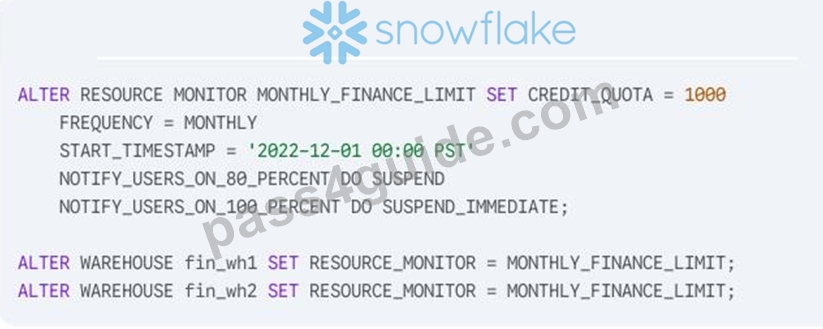
Given that the combined total of credits consumed by fin_wh1 and fin_wh2 (including cloud services) has reached 800 credits and both warehouses are suspended, what should the ACCOUNTADMIN execute to allow both warehouses to be resumed? (Select TWO).
- A. ALTER RESOURCE MONITOR MONTHLY_FINANCE_LIMIT RESET;
- B. ALTER WAREHOUSE fin_wh1 UNSET RESOURCE_MONITOR MONTHLY_FINANCE_LIMIT;
- C. ALTER RESOURCE MONITOR MONTHLY_FINANCE_LIMIT SET CREDIT_QUOTA = 1500;
- D. ALTER WAREHOUSE fin_wh1 RESUME;
- E. ALTER WAREHOUSE fin_wh2 RESUME;
- F. ALTER WAREHOUSE fin_wh2 UNSET RESOURCE_MONITOR MONTHLY_FINANCE_LIMIT;
- G. ALTER WAREHOUSE fin_wh1 UNSET RESOURCE_MONITORS;
Answer: A,C
Explanation:
❗ Scenario:
Resource Monitor MONTHLY_FINANCE_LIMIT has a credit quota of 1000.
800 credits have been used and warehouses are already suspended.
According to monitor configuration:
At 80%, warehouses are suspended.
At 100%, warehouses would be suspended immediately.
Warehouses cannot resume until the monitor is reset or the quota is increased.
✅ E. SET CREDIT_QUOTA = 1500
Increases the monthly credit limit to 1500.
Since current usage is 800 < 1500, this puts usage below 80%.
This allows resumption of warehouses.
✅ F. RESET
sql
CopyEdit
ALTER RESOURCE MONITOR MONTHLY_FINANCE_LIMIT RESET;
Resets usage to zero for the current period.
Allows warehouses to resume immediately - same effect as a fresh cycle.
❌ Why Other Options Are Incorrect:
A . / B. ALTER WAREHOUSE ... RESUME
Won't work while the resource monitor is actively suspending the warehouses due to limits.
C . / D. UNSET RESOURCE_MONITOR
You can't remove a resource monitor from a warehouse while it is currently suspended by that same monitor.
You must first reset or adjust the monitor.
G . UNSET RESOURCE_MONITORS
Invalid syntax - there's no RESOURCE_MONITORS plural keyword.
SnowPro Administrator Reference:
Resource Monitors Overview
ALTER RESOURCE MONITOR
Best Practices for Controlling Warehouse Credit Usage
NEW QUESTION # 21
......
With the protection of content and learning methods on our ADA-C01 study guide, you will not have to worry about your exam at all. Of course, if you have any suggestions for our ADA-C01 training materials, you can give us feedback. Our team of experts will certainly consider your suggestions. Perhaps the next version upgrade of ADA-C01 Real Exam is due to your opinion. In order to thank you for your support, we will also provide you with some benefits.
ADA-C01 Test Dumps Demo: https://www.pass4guide.com/ADA-C01-exam-guide-torrent.html
- Pass Guaranteed Quiz Useful Snowflake - Exam ADA-C01 Quick Prep ⏯ Search for 「 ADA-C01 」 on “ www.exams4collection.com ” immediately to obtain a free download ?ADA-C01 Customizable Exam Mode
- ADA-C01 Reliable Test Syllabus ? Download ADA-C01 Free Dumps ⏮ ADA-C01 Reliable Exam Questions ✋ Search for “ ADA-C01 ” on [ www.pdfvce.com ] immediately to obtain a free download ?ADA-C01 Reliable Test Syllabus
- Pass Guaranteed Quiz Useful Snowflake - Exam ADA-C01 Quick Prep ? Search for ➤ ADA-C01 ⮘ on ( www.exams4collection.com ) immediately to obtain a free download ?ADA-C01 Test Engine
- ADA-C01 Reliable Exam Questions ? ADA-C01 Reliable Test Syllabus ? ADA-C01 Exam Torrent ? Open ▛ www.pdfvce.com ▟ enter ( ADA-C01 ) and obtain a free download ?ADA-C01 Reliable Exam Test
- ADA-C01 Latest Test Guide ? ADA-C01 Exam Torrent ? Latest ADA-C01 Braindumps ? Search for ✔ ADA-C01 ️✔️ and obtain a free download on { www.prep4pass.com } ?ADA-C01 Latest Test Guide
- ADA-C01 Exam Torrent ? ADA-C01 Test Engine ? ADA-C01 Exam Braindumps ? Easily obtain free download of ▷ ADA-C01 ◁ by searching on ⇛ www.pdfvce.com ⇚ ?ADA-C01 Valid Test Tips
- ADA-C01 Latest Test Guide ? ADA-C01 Reliable Exam Test ? ADA-C01 Test Engine ⌨ Search for ➤ ADA-C01 ⮘ and obtain a free download on “ www.exams4collection.com ” ?ADA-C01 Reliable Exam Questions
- ADA-C01 Exam Braindumps ? ADA-C01 Valid Test Voucher ? ADA-C01 Reliable Exam Online ? Copy URL 《 www.pdfvce.com 》 open and search for ⏩ ADA-C01 ⏪ to download for free ?ADA-C01 Reliable Exam Online
- Comprehensive, up-to-date coverage of the entire ADA-C01 SnowPro Advanced Administrator curriculum ? Simply search for “ ADA-C01 ” for free download on { www.prep4pass.com } ✍ADA-C01 Reliable Exam Questions
- ADA-C01 Valid Test Tips ❤ Valid Test ADA-C01 Testking ⚔ Pass ADA-C01 Guide ? Open website ▛ www.pdfvce.com ▟ and search for [ ADA-C01 ] for free download ?ADA-C01 Reliable Exam Online
- High Hit Rate SnowPro Advanced Administrator Test Torrent Has a High Probability to Pass the Exam ? Easily obtain free download of ➥ ADA-C01 ? by searching on ( www.getvalidtest.com ) ?Valid Exam ADA-C01 Vce Free
- ADA-C01 Exam Questions
- course.rowholesaler.com raeverieacademy.com onlyphysics.in kurs.aytartech.com epstopikkorea.id apexeduinstitute.com courses.adgrove.co academy.myabove.ng xn--cksr0a682dnnjxvp.xn--kbto70f.com best100courses.com
DOWNLOAD the newest Pass4guide ADA-C01 PDF dumps from Cloud Storage for free: https://drive.google.com/open?id=1Kzrpg62JgsvtpqLhRVM5gXd8kEdxDjaH